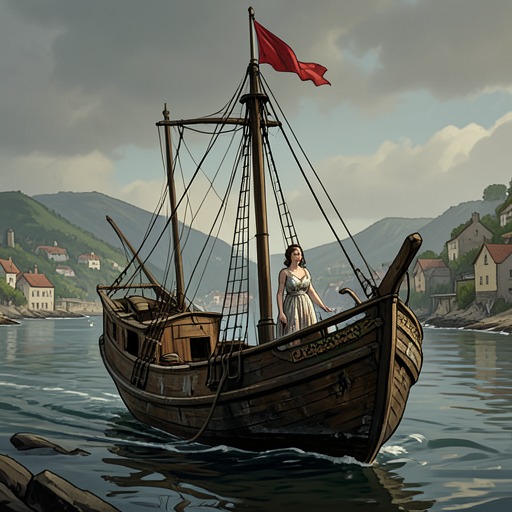
Death of Dalton Greyjoy and the Fair Isle Uprising
Fire & BloodDalton Greyjoy’s death and the Fair Isle uprising overturned the Red Kraken’s anticipated campaign in 133 AC: killed by Tess, one of his salt wives, he left a fleet that dispersed and a succession vulnerable to dispute, while the island’s people rose against the ironborn occupation. Alyn Velaryon arrived expecting to fight for the west and instead found Fair Isle free, its longships gone, and the fighting over.
Background and the Red Kraken’s power
The account sets this episode against Dalton’s control of a substantial group of salt wives and his preparations to meet Alyn Oakenfist. His fleet had gathered in the waters south of Fair Isle, with further ships off Feastfires, Kayce, and Lannisport. Dalton spoke of killing Alyn, then taking his fleet on a campaign against the Shields, Oldtown, Sunspear, and Driftmark. His plans made the approaching sea battle appear to be the decisive contest; his death before it made that confrontation unnecessary.
Dalton’s household also reflected the consequences of his conquests. He had twenty-two salt wives. Four were on Pyke, and two of those had borne him children. The others were women from the west, including two daughters of the late Lord Farman, the widow of the Knight of Kayce, and a Lannister from Lannisport rather than Casterly Rock. Others came from less powerful families of fishers, traders, and men-at-arms. The narrative notes that some had lost male relatives to Dalton’s raids, but does not establish what any particular woman felt toward him.
Tess and Dalton’s death
Tess is known to history by little more than her name. The accounts disagree sharply about her age, background, and feelings toward Dalton, and the narrative refuses to resolve those contradictions. On a rainy, windy night at Faircastle, while the longships gathered below, she killed Dalton with his own dagger as he slept. She then leapt into the sea and died. The episode gives no reliable explanation for her act beyond the circumstances it records; her motive remains as uncertain as her past.
Dalton died on the eve of the battle he had prepared to fight, not in combat with Alyn or in a confrontation with a rival captain. The reversal is central to the episode: a private act within his household ended the immediate threat he posed to the west and disrupted the military power assembled around him. The account’s emphasis on Tess’s obscurity also contrasts with the fame of the lord she killed. The history can name the ruler and count his ships and wives, but cannot securely tell the story of the woman whose action changed the campaign.
Succession and the Fair Isle revolt
Dalton had never taken a rock wife. His lawful heirs were therefore two young sons by salt wives, along with three sisters and several ambitious cousins. Under ironborn law, the Seastone Chair passed to his eldest salt son, Toron, who was not yet six. Toron’s mother could not expect to serve as regent in the way a rock wife might have done. The succession thus placed a child on the path to rule without providing his mother the same recognized political standing, while other relatives had their own claims and ambitions. The captains understood that a struggle for power was likely and hurried back toward the Iron Islands.
As the fleet broke apart, the smallfolk of Fair Isle and the knights still on the island rose in rebellion. Ironborn who had remained behind were attacked in their beds or at the docks, and their ships were seized and burned. Over three days, hundreds of reavers were killed; by the end, only Faircastle remained in ironborn hands. The revolt turned Dalton’s death into more than a change of lord: the islanders used the opening created by the departing fleet to challenge the occupation directly.
The garrison at Faircastle held out under Alester Wynch and Gunthor Goodbrother, two of Dalton’s close companions and brothers-in-battle. Their resistance ended not through a reported assault by Alyn’s fleet but in conflict within their own command: Gunthor killed Alester during a quarrel over Lysa, one of the salt widows. Faircastle was the last remaining ironborn stronghold on the island, making its garrison’s internal fracture part of the uprising’s final phase.
Alyn’s arrival and aftermath
When Alyn Velaryon arrived to deliver the west from the ironborn, he found that the expected battle had already been decided by Dalton’s death, the fleet’s dissolution, and the revolt. Fair Isle was free, the longships had fled, and the fighting had ended. As Lady Baela passed beneath the walls of Lannisport, the city’s bells rang in welcome and thousands came out to cheer. Lady Johanna Lannister presented Alyn with a gold seahorse and other tokens of Lannister esteem.
The welcome did not remove the west’s vulnerability. With its own fleet destroyed, the region feared a return by the ironborn under Dalton’s eventual successor. Lady Johanna proposed an attack on the Iron Islands and offered to supply the troops; Alyn refused the punitive expedition. He did, however, agree that Leo Costayne would remain at Lannisport with a third of the fleet until the Lannisters, House Farman, and other western lords could rebuild enough warships to defend themselves. Alyn took the rest of his fleet back to sea and continued his homeward voyage.
Significance
The event links three political consequences: Dalton’s unexpected death, the resulting uncertainty over succession, and the rapid withdrawal of the force he had assembled. The revolt on Fair Isle was enabled by that withdrawal, while Alyn’s arrival confirmed that the west had been freed without the naval battle he had set out to fight. Yet the settlement remained provisional: the west still needed a fleet of its own, and the succession on Pyke had not been resolved. The episode’s surviving account also preserves a deliberate limit on what can be known. Tess’s act and its consequences are clear; her identity beyond her name and the reason she acted are not.